
The AREM Symposium
AREM stands for “Archiving and Re-Performing Electroacoustic Music.” The first AREM symposium took place on December 14, 2018, in Bayreuth and has been organized by Miriam Akkermann every two years since then. The symposia thus regularly bring together researchers from various disciplines and with diverse backgrounds to discuss issues related to the archiving and re-performance of electroacoustic music, computer music, and digitized music.
This is because work in the field of electroacoustic music and early computer music is directly linked to the challenges posed by rapidly evolving (digital) technologies. These challenges range from the short lifecycles of technical devices and compatibility issues between different generations of technology to the question of how the long-term archiving of this data can be ensured.
Furthermore, in electroacoustic music, technical (digital) advancements and artistic ideas have developed in close interrelation with one another. How can and should compositions and performances of electroacoustic music be documented, preserved, and/or archived? Who decides what is archived, and who is responsible for maintaining the data (and the hardware), ensuring accessibility, and ensuring compatibility? What strategies and approaches have already been pursued, including with regard to interdisciplinary and methodological collaboration with musicologists, music practitioners, sound engineers, and computer scientists?
Program AREM 2026
Friday, 27th November 2026
10.00 - 10.15: Registration Workshop
10.15 - 12.30: Hands-on Workshop
Workshop Description
The Antony project was initiated in response to the challenges associated with the long-term maintenance of technical components in mixed music works.
Intrinsically linked to the lifespan of constantly evolving software and to non-interoperable programming languages, the preservation of a mixed work often depends solely on the ability of a small number of individuals —computer music designers, composers, sound engineers, etc. —to update the developed programs (patches, computer code, score files, etc.) each time the work is revived, thereby conditioning its long-term viability on its performances. To these difficulties, inherent in works employing digital technologies, is added a further challenge related to preservation and dissemination: with the exception of the Sidney database (a digital archive of mixed works created at IRCAM), very few sustainable initiatives have enabled the systematic organization and preservation of patches, both for safeguarding purposes and for making them available to artists and researchers.
The Antony platform is designed to enable the deposit of digital archives, accompanied by comprehensive descriptions of the content and file formats, as well as the definition and management of access rights to the files and associated documentation. It incorporates advanced functionalities for data search, consultation, and retrieval, with the objective of ensuring the study, porting, re-execution and reproducibility of the artistic works.
To begin this workshop we will briefly present an overview of other (existing or discontinued) initiatives related to online databases for experimental music creation. We will compare the features they propose and discuss the question of their long term sustainability.
Antony has been developed in strict compliance with Semantic Web standards and best practices. The project relies on established norms and technologies of the WEB3.0, including the use of formal knowledge representation models, standardized vocabularies, and interoperable data structures, in order to ensure semantic interoperability, extensibility, and long-term sustainability of the data. The preservation and dissemination of collaborative mixed music works raise significant legal and copyright challenges due to the multiplicity of contributors, the integration of digital technologies, and the technical complexity of these works. Each component—ranging from audio recordings and score files to software patches and interactive scripts—may be subject to distinct copyright protections, licensing terms, or moral rights. This complexity is further compounded when works involve collaborations across different institutions, countries, or digital platforms, each with potentially divergent legal frameworks.
Restricted users and file permissions play a critical role in addressing these challenges. Implementing granular access controls ensures that only authorized users can access, modify, or redistribute the digital assets, thereby helping to respect licensing agreements and protect the intellectual property of all contributors. Fine-grained permissions can also support differentiated access for performers, researchers, educators, or the general public, balancing openness and legal compliance. Furthermore, robust metadata and documentation are essential for tracking rights, attributions, and usage restrictions. Standardized rights metadata can facilitate the lawful reuse of materials, enable automated enforcement of permissions, and provide transparency for future interpretations or reconstructions of the works. Overall, careful legal and technical governance is crucial to guarantee both the sustainability and ethical dissemination of collaborative mixed music works while maintaining compliance with copyright law.
Workshop participants will be able to register for an account on the Antony platform and deposit the constituent elements of their artistic creations, including musical scores, patches, audio recordings, DAW session files, technical documentation, etc. Each deposited element can be identified and documented manually. The platform will store these materials in a structured and interoperable database, ensuring long-term preservation, reproducibility, and accessibility for authorized users. This approach supports both scholarly research and creative practice, and facilitates future reuse and dissemination of the works.
Based on our extensive experience with artistic and interactive works that integrate digital technologies, we will develop and recommend a set of best practices for the documentation of technologically mediated artistic creations. These best practices include considerations about standards, file formats, documentation style and data curation. As Antony is an open-source platform licensed under LGPL, it can be deployed as a local instance of the database. Participants who prefer not to store their data on the CNSMDP-hosted version of Antony have the option to install and run the software on their own computers. For participants interested in this approach, we can provide guidance and practical instructions to facilitate a local installation.
Workshop structure
- Presentation of the context
- Comparison with present and past existing databases (such as Sidney)
- Introduction to the ontologies and thesauri used
- Discussion of legal and copyright issues implied by the preservation and diffusion of collaborative mixed music works
- Restricted users File permissions
- Hands-on
Technologies used in Antony
- Python
- Semantic web
- CubicWeb (Logilab)
- Postgresql
- Ontologies: CIDOC-CRM, FRBRoo/LRMoo, DOREMUS
References
Project websites:
https://musinf.univ-st-etienne.fr/recherches/antony.html
https://antony.demo-dedibox.logilab.fr
Selected Publications:
FOUILLOU, Malena ; LEMOUTON, Serge ; POTTIER, Laurent ; WARNIER, Jacques ; BOTTINI Thomas, BONARDI, Alain, « Vers une préservation pérenne du répertoire des œuvres musicales avec électronique : développement du système Antony » (Towards long-term preservation of the repertoire of musical works with electronics: development of the Antony system”), Proceedings of the Journées d'Informatique Musicale 2025 (JIM 2025), GRAME, Inria, 2025, Lyon, https://hal.science/hal-05102314
LEMOUTON, Serge ; BONARDI, Alain ; POTTIER, Laurent ; WARNIER, Jacques, « On The Documentation of Electronic Music », Computer Music Journal, 42:4, p. 1–18, Winter 2018.
LEMOUTON, Serge ; BONARDI, Alain ; POTTIER, Laurent ; WARNIER, Jacques, « Electronic music documentations, practices and models », Proceedings of the International Computer Music Conference, (ICMC), Daegu (Corée), August 2018.
BONARDI, Alain ; LEMOUTON, Serge ; POTTIER, Laurent ; WARNIER, Jacques, « Présentation du groupe de travail AFIM, "Archivage collaboratif et préservation créative" », Proceedings of the Journées d'informatique musicale (JIM2018), Amiens, 2018, p.11-12 .
About the workshop leaders
Serge Lemouton: Computer Music Designer - Institut de Recherche et Création Acoustique/Musique - Centre Georges Pompidou (IRCAM-CGP)
Since 1992, Serge Lemouton works as a computer music designer at IRCAM, collaborates with researchers to develop computer tools and has taken part in the production and public performances of numerous composers’ musical projects. He is currently working on score following systems, analysis of instrumental gesture and constraint programming for computer assisted composition. His current research work leads him to study the transmission and preservation of the computer music repertoire.
Jacques Warnier: Research Engineer, Ministry of Culture – Computer Music Realizer (RIM), Conservatoire National Supérieur de Musique et de Danse de Paris (CNSMDP)
Since 2007, Jacques Warnier has supported the composition and new technologies class at CNSMDP, producing concerts and performing live electronics for mixed repertoire works. After earning the Saint-Etienne Master’s degree in Computer Music Design in 2015, he joined the Ministry of Culture as a research engineer in 2016. His role combines musicianship and engineering to create the artistic and technical conditions required for performing 20th- and 21st-century music involving audio-digital technologies. His research focuses on making this repertoire accessible to students: curating works by instrument, acquiring scores and electronic parts, cataloging them in the Hector Berlioz media library, and preserving or reconstructing electronic components. He is a member of the AFIM working group on “Collaborative Archiving and Creative Preservation” (since 2018), now “Antony,” and participates in the Humanum consortium for digital musicology (Musica2) since 2022.
Practical Information
The workshop will take place Friday 27.11.2026 10-12.30 at TU Dortmund in context of AREM Symposium. Attendance is free of charge but requires registration by mail to symposium.arem@gmail.com
Please bring your Laptop to the workshop.
12.30 - 13.30: Lunch break
13.30 - 14.00: Registration Symposium
14.00 - 14.15: Welcome!
14.15 - 15.45: Documentation for Preservation (Session 1)
About Marcus Erbe
Marcus Erbe is currently a scientific adviser for Ensemble Musikfabrik Landesensemble NRW, cataloguing sources from the WDR Studio for Electronic Music in Cologne in close collaboration with the Historical Archive of the City of Cologne. He studied musicology, German studies and education, held research and academic posts in media studies and musicology from 2002 to 2017, and subsequently held the Junior Professorship in Sound Studies at the University of Cologne until 2025. During this time, he organised the Raum-Musik lecture and concert series with institutions and composers from Germany and abroad. He also directed the institute’s sound studio, including its international archive of multichannel electroacoustic music. Erbe supervised research and public engagement projects in electroacoustic music, cultural mediation, sound art and voice. To date, he has taught over 100 seminars, lectures and workshops at universities and arts institutions. His research and teaching encompass twentieth- and twenty-first-century music history, sound and media art, vocal performance and mediation, gender studies, generative AI, virtual and augmented reality, audiovisuality in films and games, digital music production, sound design, acoustic ecology, soundwalking, fan studies, music and extremism, and music philosophy.
Carsten Reinhardt is professor for historical studies of science at the University of Bielefeld, and co-director of the Institute for Studies of Science (ISoS). From 2013 to 2016, he was President and CEO of the Science History Institute in Philadelphia, USA. Between 2014 and 2023, he has co-directed the research program on the history of the Max Planck Society. Reinhardt's overall research fields are the history of chemistry, industrial research, scientific instrumentation and expert knowledge. For his co-authored book Residues. Thinking Through Chemical Environments, Rutgers UP 2022, he received the 2023 Robert K. Merton Award of the American Sociology Association (Science, Knowledge, and Technology Section). In 2024, he received the Morris Award of the Society for the History of Chemistry, recognizing scholarly achievement in the History of Modern Chemistry or the History of the Chemical Industry. Together with Gabriele Gramelsberger (Aachen) and Ulf Hashagen and Helmuth Trischler (Munich) he co-directs the Edition of Scientific Software, a long-term project funded by the Union of German Science Academies.
About Mark Gergis
Mark Gergis is a London-based Iraqi-American producer, composer, audio-visual archivist, and researcher whose work centres on music made at the margins of official culture, across borders and diasporas, often examining forms that circulated beyond institutions, commercial infrastructures, and formal archives. He is founder and co-director of Syrian Cassette Archives, an archival and research initiative dedicated to preserving Syria's cassette-era culture. Alongside this, Gergis has compiled and produced numerous releases highlighting underrepresented musical traditions, working with artists including Syria's Rizan Said, Vietnamese singer Phương Tâm, and Turkish psychedelic rock pioneer Erkin Koray, through labels including Sublime Frequencies. He works across music production, sound restoration, and sound design for film and exhibitions, and produces sound and music under his own name and the long-running project Porest, bridging composition, audio collage, performance, and radio dramas. His 2003 audio documentary I Remember Syria, a sound portrait of pre-war Syria, was reissued in 2015 with proceeds supporting Syrian relief causes. He was also responsible for bringing Omar Souleyman to international attention in the 2000s, producing and managing the artist for several years.
About Yamen Mekdad
Yamen Mekdad is a Damascus/London-based Syrian artist, researcher, and community organizer whose work is rooted in radical collaboration. His practice explores the relationship between sound, geography, and the human condition, shaped by sustained engagement across Syria and its diasporas. Working across filmmaking, archiving, field recording, radio, and grassroots cultural organizing, Mekdad has co-founded initiatives including Dandana, Sawt of the Earth, Makkam, and Sadaa Sound Syndicate. He is the co-founder and Creative Director of Syrian Cassette Archives and Rock Paper Scissors, and the co-founder and audio curator of the Syrian Arts and Culture Festival. He also directed Sawt Syria in collaboration with Boiler Room.
His practice is rooted in sonic research and speculative methodologies, positioning sound as a site for reflection, experimentation, and collective meaning-making. His work has been presented across international platforms, festivals, and cultural institutions such as Rewire, Le Guess Who?, HKW, Turner Contemporary, NTS, Al Hara, Onassis Stegi, Mosaic Rooms, among others.
Most recently, his essay-film Shapeshifting premiered at Sheffield DocFest, reflecting on the fractured Syrian psyche in the two years preceding the regime's collapse through underground music scenes in Syria and across the Syrian diaspora in Europe.
15.45 - 16.15: Coffee break
16.15 - 18.00: Learning from Archival Material using AI (Session 2)
Matthias Pasdzierny is a tenure track academy professor at Berlin University of the Arts and Berlin-Brandenburg Academy of Sciences and Humanities, he leads the Berlin office of Bernd Alois Zimmermann-Gesamtausgabe (www.zimmermann-gesamtausgabe.de). His research areas are: history of music after 1945, critical edition of 20th century music, music and migration/exile, aesthetics and history of Techno/EDMCs.
Eve M. Zucker is a sociocultural anthropologist and Research Affiliate in the Department of Anthropology at Yale University. She is co-founder of the international research group, Digital Archive of Memorialization of Mass Atrocities (DAMMA), and she co-founded the Digital Memorialization of Mass Atrocities Program within the Yale Genocide Studies Program. She also serves as President and CEO of the Center for Khmer Studies. Her research examines remembrance of mass violence, digital memorialization, AI ethics, and cultural heritage preservation, particularly regarding the Holocaust and Cambodian genocide.
Gerriet K. Sharma is a Berlin-based composer, media artist, and artistic researcher whose work investigates the intersection of music, sound, and interdisciplinary spatial practices. For more than two decades, he has explored the spatialisation of electroacoustic and instrumental music through Ambisonics, Wave Field Synthesis, and sculptural approaches to sound. His research focuses on transforming compositional structures into immersive three-dimensional sonic environments, AI-assisted compositional practices, and hybrid performative systems.
He studied Media Art at the Academy of Media Arts Cologne and Composition and Computer Music at the University of Music and Performing Arts Graz, completing his artistic-scientific doctorate in 2016. His work has been presented internationally, including at the Darmstadt Summer Course, Music Biennale Zagreb, Wiener Festwochen, and Berlin Art Week. Sculptural works for the Icosahedral Loudspeaker (IKO) have become a defining element of his practice.
Sharma served as Senior Artistic Researcher on Orchestrating Space by Icosahedral Loudspeaker and held visiting professorships at Technische Universität Berlin (2017/18) and Karlsruhe University of Arts and Design (2022–2024). Since 2025, he has been a Fellow at TU Berlin’s Electronic Studio.
His publications include Aural Sculpturality – Spatio-temporal Phenomena within Auditory Media Techniques (2019), while his binaural spatial sound model firniss redux formed part of lumbung radio at documenta fifteen. He co-founded the Lab for Spatial Aesthetics in Sound (spæs) and initiated the SAR Special Interest Group Spatial Aesthetics and Artificial Environments. In 2026, he received the Musikfonds AI in Music fellowship for Shadow Material and is co-curator of Crushed Now – After Turing // Beyond Presence, a concert series on Hybrid Spatiology in Music.
Marina Bosi, a pioneer in digital audio coding and a leading contributor to audio technology standards, is a founding director and treasurer of the Moving Picture, Audio and Data Coding by Artificial Intelligence (MPAI) and serves as Chair of the IEEE SA MPAI-CAE Working Group. A past president of the Audio Engineering Society (AES), she has held senior leadership positions including Chief Technology Officer of MPEG LA and Vice President of Technology at DTS. At Dolby Laboratories, Dr. Bosi was part of the team that created Dolby Digital and led the development of MPEG-2 AAC, for which she received the ISO/IEC 1997 Editor Award. A graduate of Stanford Graduate School of Business Executive Program, she holds degrees in Physics and Music from the University of Florence, completed her dissertation at IRCAM in Paris, and served on several boards. An internationally recognized speaker, inventor, and author, Dr. Bosi holds multiple patents and authored the textbook Introduction to Digital Audio Coding and Standards. Her honors include the AES Silver Medal in recognition of outstanding achievements in the development and the standardization of audio coding.
18.00 - 18.15: Break
18.15 - 20.00: Film screening (on-site only!)
“Salamiyah - Lady of the Land”
- Directed by Yamen Mekdad and Omar Malas
- Produced by Syrian Cassette Archives
- Q&A with Mark Gergis and Yamen Mekdad
Saturday, 28th November 2026
09.30 - 11.00: Personal Archives (Session 3)
More information about the speakers will be uploaded soon!
Monica Lim is an Australian experimental artist and composer. Trained in classical piano, she merges traditional artforms with new technologies, always asking what the future of music is. Her work resists categorisation, melding embodied movement, participatory practice, circuitry and spatial design with baroque classicism, computer code, glitch and noise. Her work has been presented at major national and international platforms and received awards such as the Green Room Award, Theatre NOW Award and the Guthman Musical Instrument Competition. She has a doctoral degree in Interactive Composition from the University of Melbourne. Her research interests lie in interactive composition, artificial intelligence for musical creativity, embodied sound and digital musical instrument design.
Fabian Czolbe (*1981) studied musicology, art history and philosophy in Berlin, was a scholarship holder of a DFG-funded research training group and received his PhD in 2011 with a thesis on aspects of notational iconicity in Henri Pousseur's compositional sketches. He was a postdoc at the Institute for Musicology Weimar-Jena (DFG project, 2015-2019), is a research assistant at the Hamburg University of Music and Performing Arts / ligeti zentrum since 2023 and has taught at universities in Berlin, Weimar, Freiburg and Marburg.
His research focuses on music and music theater of the 20th/21st century, experimental/improvised music, instrumental theater, sound art/sound performance, music aesthetics, notation and compositional writing and creative processes in music.
11.00 - 11.30: Coffee break
11.30 - 12.30: Archiving the invisible (Session 4)
Bojana Radovanović Šuput is a musicologist, art theorist, and Senior Research Associate at the Institute of Musicology of the Serbian Academy of Sciences and Arts (SASA). She earned her PhD from the Faculty of Music in Belgrade with a dissertation examining the relationship between voice, vocal technique, and new technologies in contemporary art and popular music.
Her research focuses on contemporary music and art, voice studies, metal music, art and media, and research methodologies in art, music, and musicology. She is the author of three monographs and has served on the editorial teams of numerous edited volumes and other scholarly publications.
She is the co-founder of the Association for the Preservation, Research and Promotion of Music "Serbian Composers", as well as co-founder and Editor-in-Chief of the INSAM Journal of Contemporary Music, Art and Technology (Sarajevo, Bosnia and Herzegovina).
Performing as AGF, East German-Finland based poetess, language maker and media artist Antye Greie-Ripatti utilises language, electronics, explores the quantum within the depths of sound & music sculpting glowing post-internet tapestry as @poemproducer
12.30 - 13.30: Repertoire in Transformation (Session 5)
More information about the speakers will be uploaded soon!
About Luis Ernesto Gómez Quintero
Luis Ernesto Gómez is a composer, music researcher, and writer. He holds a master’s degree in music from Simón Bolívar University (2011), a bachelor’s degree in music from IUDEM (2006), and a bachelor’s degree in computer science (University of Carabobo, 1999). He studied at El Sistema's Latin American Composition Chair with Blas Atehortúa from 2003 to 2005, as well as with Federico Ruiz (IUDEM) and Diana Arismendi (USB), and electroacoustic music with Adina Izarra. His "Concerto for Orchestra" won the "Antonio Estévez" First Prize (1st National Music Composition Competition 2010, Venezuelan Symphony Orchestra), and his debut work, "Dialéctica de lo Incierto," won the 2003 Municipal Music Prize. His works have been performed in the United States, Italy, Germany, Switzerland, Sweden, Chile, the United States, and Panama. He publishes with Cayambis Music Press (Virginia, USA) and Babel Scores (Paris, France). He is a Professor and Coordinator of the Master's Program in Music at Simón Bolívar University, Chief of the Digital Music Laboratory, and a Researcher at the El Sistema Research Center. As a writer, he was invited to the 9th International Poetry Festival of El Salvador 2010 (Fundación Poetas de El Salvador) and the 22nd International Poetry Festival of Genoa 2016 (Stanza della Poesia). He published the poetry collection "El Sabio Azar" (Editorial Eclepsidra, 2023). In 2026, he co-authored an article with Diego Morales on the history of the Digital Music Laboratory at Universidad Simón Bolívar, published in Cambridge University's Organised Sound journal.
About Diego Morales
Diego Morales is a Venezuelan lecturer and composer. He won the 2nd Prize at the „Klang der Welt" Composition Competition (Deutsche Oper Berlin, 2011). He has participated in the Latin-American Music Festival three times (2016, 2018, 2024). From August 2021 to September 2022, he participated as a mentee in the „Digitales Mentoring-Programm Zeitgenössische Musik" (Goethe Institut) working with Marco Blaauw. He obtained his master's degree in Music Composition Graduated with Honors at Universidad "Simón Bolívar" (USB) with an investigation on polytemporality: "The Polytemporal Object. Strategies towards Rhythm Speculation based on Metronomic Observations" (2022). In 2023 he attended three International Music Theory conferences as lecturer discussing Polytemporality and Composition (Pavia: April 2023), Polytemporality and Pedagogy (Barquisimeto: May 2023) and Polytemporality and its systematized theory (Salerno: October 2023). He is a lecturer at Universidad Simón Bolívar. His lines of research address rhythm, tempo, electronic music and Latin-American music.
13.30 - 14.30: Performance by Gerriet K. Sharma (on-site only!)
14.30: Farewell and end of the Symposium
Save the Date: AREM 2026 on 27th & 28th November 2026!
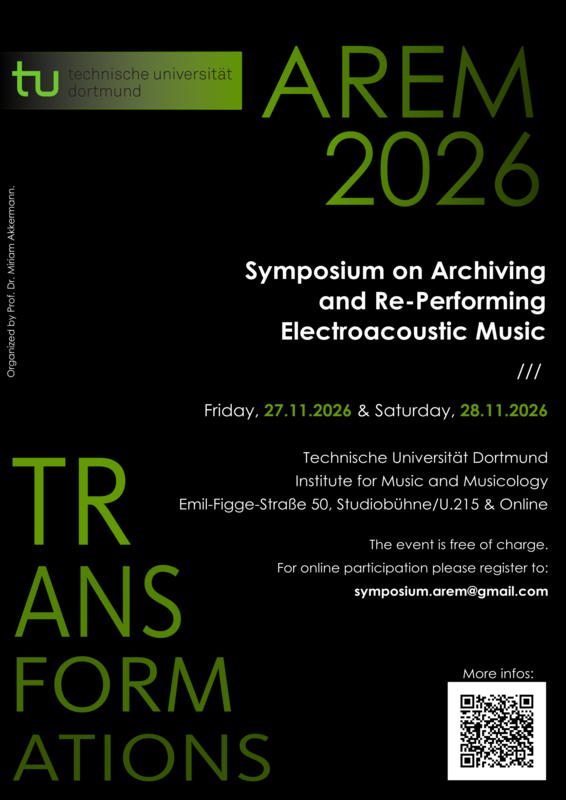
The “Symposium on Archiving and Re-Performing Electroacoustic Music” (AREM) will take place on November 27 and 28, 2026, at TU Dortmund University. Under this year’s theme, “Transformations,” researchers from various disciplines will once again come together to discuss electroacoustic music, computer music, and digitized music.
- The event is free of charge
- For online participation please register to symposium.arem@gmail.com
- No registration needed for On-Site-Participation - just drop in!
We look forward to welcoming you to AREM2026!
Past Symposia
Everything we know about music derives from a very heterogeneous set of sources including the live experience, related objects, paper-based sources, and nowadays also more and more digital content. With the transfer of digital or digitized content and connected technologies into archives, it is necessary to change both native digital and digitized content into archivable formats and selections. This requires creative solutions for the challenge of transferring these sources to archiving institutions and being able to store them there. How to structure and classify this content related to the non-digital sources? What is archived and what is not – and how may this influence future performances? Or are completely different approaches needed to preserve pieces of music for analysis, listening and performance? Participants from various fields such as music research, archival science, media studies, archiving institutions and performance will present their projects and ideas, and discuss the various approaches and challenges.
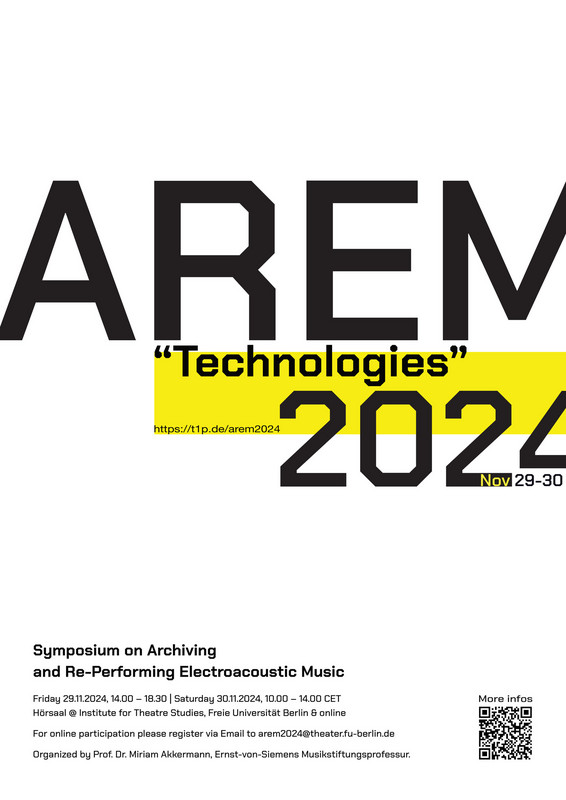
The fourth edition of the biannual Symposium on Archiving and Re-Performing Electroacoustic Music AREM takes place on Friday, November 29th in the afternoon and November 30th in the morning. The interdisciplinary and international symposium will follow the topic “Technologies”.
The symposium is organized by Prof. Dr. Miriam Akkermann, Ernst-von-Siemens Endowed Professorship, Freie Universität Berlin.
Friday, 29th November 2024
14.00: Virtual and real doors open
14.15 - 14.30: Welcome!
- Miriam Akkermann
14.30 - 16.00: Institutional approaches (Session 1)
- Matthias Kassel (Paul Sacher Stiftung, Basel): “Digital Shelving: Examples from the Paul Sacher Foundation's Hybrid Archive“
- Lara Le Drian (Philharmonie Luxembourg): “Preserving and promoting audiovisual collections in an active cultural institution: the forgotten and changing collections at the Philharmonie of Luxembourg”
- Thomas Neuhaus (Folkwang University of the Arts), Sarah Youssef (Managing Director, Digi-Kunst.nrw): "Challenges in Archiving Non-Text-Based Media at Art and Music Academies: ICEM as a Case Study and the Digi-Kunst.nrw Project as a Potential Solution"
16.00 - 16.30: Coffee Break
16.30 - 17.30: Needs and demands (Session 2)
- Mara Helmuth (University of Cincinnati): Impulse: “A Composer's View on Sustaining Interactive Music Performance“
- Anna Schäffler: Impulse: “Adapting Archival Practice: Paradigm Shifts due to Contemporary Challenges”
17.30 - 18.30: Networks and data bases (Session 3)
- Anita Jóri (Leuphana Universität Lüneburg): Impulse: “‘Morgen ist die Frage‘: On the Necessity of Archiving Berlin's Techno Histories”
- Marc Battier: “Framework for documenting East Asia Electroacoustic Musical Works: The EMSAN database”
Saturday, 30th November 2024
10.00: Virtual and real doors open
10.15 - 11.45: Re/Presentation (Session 4)
- Melissa Portaels (Artes KU Leuven Libraries): Impulse: “Luc Brewaeys’ Symphonic Legacy”
- Nadja Wallaszkovits (ABK Stuttgart): “The restoration of the video installation Joseph Beuys CELTIC + ~~~. Reflections on the technical realisation and re-assembling in the context of the exhibition 'On Air: The Sound of the Material in Art from the 1950s to the 1970s', Kaiser Wilhelm Museum Krefeld”
- Felix Mittelberger (ZKM Karlsruhe): “Reconstructing Harald Bode. From Archive to Ear”
11.45 - 12.15: Coffee Break
12.15 - 13.45: Maintenance, restoration, and beyond (Session 5)
- Pierre Couprie (Paris-Saclay University, RASM-CHCSC) and Nathanaëlle Raboisson (Motus Musical Ensemble, IReMus): “Documentation, Analyses and Models of Loudspeaker Orchestras: The Acousmonium as a Case Study”
- Miller Puckette and Serge Lemouton (IRCAM, Paris): “Jupiter: a Case Study in Live Electronic Music Preservation”
- Victor Zappi (Northeastern University): “LDSP: Hacking Mobile Phones to Preserve Technology and Music Beyond Obsolescence”
13.45: Farewell!
Archiving music involving digital technologies becomes a more and more urgent task. This comprises born digital sources as well as digitized content and also applies to information held in digital repositories. Besides challenges such as providing and maintaining adequate facilities, a major question is also how to deal with these digital sources. How can they be structured and classified to grant accessibility? What role does it play to ‘be online‘? And how can performative aspects be integrated in digital sources?
Friday, 09.10.2022; 14.00 - 17.30 p.m.
14.00 – 14.15: Virtual doors open
14.15 – 14.30: Welcome
- Miriam Akkermann
14.30 – 16.00: Strategies and Approaches (Session 1)
- Giulia Sarno: Connecting the dots: activation strategies for an archive of electronic music
- Hannah Bosma: Archiving STEIM
- Nausikaä El Mecky: The Danger of Uploading an Image - Some thoughts on the ephemeral eternity of digital archives
16.00 – 16.30: Coffee Break
16.30 – 18.00: Data and Access (Session 2)
- David Lewis: Music Encoding and Linked Data: A flexible approach to sharing musical information online
- Sarah-Mai Dang: Situation Sources. On Research Data Management and Film History
Saturday, 10.12.2022; 9.15 - 12.45 p.m.
9.15 – 9.30: Virtual doors open
9.30 – 11.00: Sources (Session 3)
- Serge Lemouton, Miller Puckette: Preventive restoration of early real-time repertoire pieces
- Mikako Mizuno: Archiving on text documentation and/or events information; multiple sources of Japanese electroacoustic pieces
- Andreas Münzmay: Data - algorithms - new insights? Digital heuristics in musicology
11.00 – 11.30: Coffee Break
11.30 – 12.30: Dynamics (Session 4)
- Karin Lingnau: Aspects of collecting the immaterial and the speculative
- Annet Dekker: The tension between static documentation and dynamic art
12.30: Farewell
Archiving music that involves digital technologies causes new challenges for institutions, libraries and archives, ranging from providing server facilities and maintaining hard- and software to questions of systematizing the now divers, partly digital sources. How can and should these new sources be preserved and archived? Who selects the sources that are maintained? Who takes care about maintaining the accessibility of the archived sources? How is archiving digital media influenced by legal issues? How do other research fields such as media studies, film studies or game studies deal with those questions? And how is archiving music related to the new developments in digital music editions?
Attached to the Symposium, the workshop „What do we need to do to archive music?“ took place.
Sustainable archiving in this very special field of electroacoustic music, dealing with objects that may include several different media formats as original sources, requires the interdisciplinary exchange. The workshop will provide a first platform for exchange among the main positions involved in order to exchange on their subject-specific ideas and goals, and may serve as a starting point for further research as well as ultimately motivate new activities in this interdisciplinary field.
Friday, October 23, 2020
10.00 – 10.15: Virtual doors open
10.15 – 10.30: Welcome
- Miriam Akkermann, TU Dresden (GER)
10.30 – 12.00: Libraries and Archives (Session 1)
- Serge Lemouton, IRCAM (F): The Electroacoustic Repertoire: Is there a Librarian?
- Barbara Wiermann, SLUB (GER): Gaps in memory? How do we archive electro-acoustic music in Germany?
- Anne Lauber-Rönsberg, TU Dresden (GER): Copyright Law Issues of Archiving and Re-performing Electro-Acoustic Music
12.00 – 14.00: Coffee Break
14.00 – 16.00: Preservation strategies (Session 2)
- Kevin Dahan, DeMontfort University (GB): Towards Effective Preservation of Electroacoustic Music
- Tae Hong Park, NYU (USA): Towards Crowd-Sourced Curating, Archiving, and Preserving Electro-Acoustic Music
- Guillaume Boutard, University of Montreal (CAN): Prospecting for Digital Preservation of Electroacoustic and Mixed Music
16.00 – 16.30: Coffee Break
16.30 – 18.00: Preserving and Re-Performing (Session 3)
- Seth Cluett, Colombia University (USA): Preserving In Place: Reconstructing the RCA Mark II
- Lucas Bennett, Basel University (CH): (Re-)Performing and Documenting Live Electronic Musik from the last 30 Years
Saturday, October 24, 2020
10.00 – 10.30: Welcome
10.30 – 12.30: Projects and best practice (Session 4)
- Franziska Heller, Zürich University/Film University Babelsberg KONRAD WOLF (CH/GER): Film and archiving within digital cultures
- Bernhard Lutz, Bavarian State Library (GER): Long-term Archiving in the Specialised Information Service for Musicology (musiconn)
- Folkmar Hein, emerit. TU Berlin (GER): Statistics on Electroacustic Music
12.30 – 14.00: Coffee Break
14.00 – 16.00: Workshop „What do we need to do to archive music?“
- Impulse statements by Frédéric Dufeu, University of Huddersfield (GB), Andreas Münzmay, Paderborn University (GER), and Benjamin Bohl, Frankfurt University (GER), and co-workshop organizer Axel Berndt, CEMFI (GER).
- The workshop consisted of initial impulse statements followed by a structured discussion and an open panel round with all workshop participants.
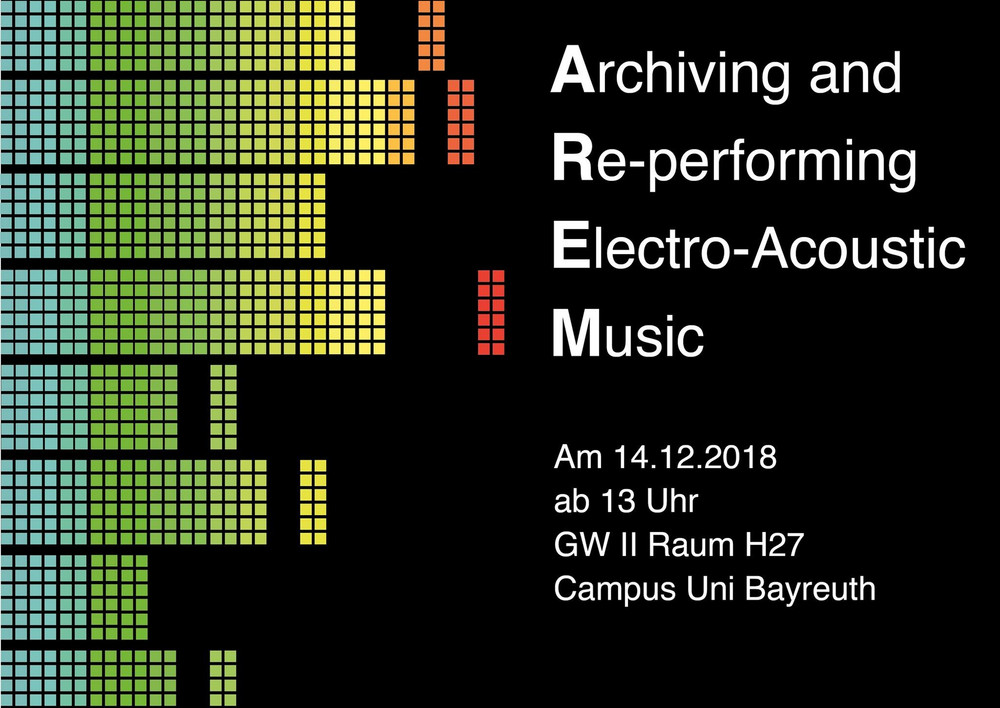
Program
13.00: Welcome and Opening
- Miriam Akkermann, Universität Bayreuth (GER)
13.30 – 14.30: Re-performance / Re-construction (Panel 1)
- João Romão, MPI/HU Berlin (GER):
Music-technical labour: Kontakte’s realisation score as a cultural artefact. - Kevin Dahan, DeMontfort Universtiy Leicester (GB)
Reconstruction as preservation strategy
14.30 – 15.00: Coffee Break
15.00 – 16.30: Preservation / Archiving (Panel 2)
- Hannah Bosma, (NL):
Preservation as performance: liveness, loss and viability in electroacoustic music - Laura Zattra, Konservatorium A. Boito, Parma/Konservatorium F. Venezze, Rovigo (I):
The Preservation of Electroacoustic Music Heritage throughout Italy - Serge Lemouton, IRCAM Paris (F):
Preservation strategies for the electroacoustic works from Ircam and other french national centers for musical creation
16.30 – 17.00: Coffee Break
17.00 – 18.30: Archiving projects in progress (Panel 3)
- Julia Heimerdinger, Universität für Musik und darstellende Kunst, Wien (AUT):
Digital collections in music research. An experience report - Martin Roth, Universität Leipzig (GER):
Play as Research: Establishing a (multilayered) research infrastructure for Japanese video games - Henrik von Coler, Technische Universität Berlin (GER):
The TU-Berlin Archive and the EMDoku – Use, Maintanance and Future
More: https://web.archive.org/web/20201022202528/https://arem2018.medienwissenschaft.uni-bayreuth.de/